After we left Sicuani, on the last day of our Puno tour, we drove through the bustling streets of Juliaca where we had landed two days before. It was dark when we landed. We noticed the taxis as we drove through the city, making our way into the countryside, so Margaret asked Felix if we could return to Juliaca long enough to take some pictures before leaving for the day's journey to Cusco. With all the stops to take pictures and to visit unplanned sites, we were two hours late getting into Cusco. Felix and the driver had to make the six-hour return trip that night because he was guiding German tourists on a kayaking adventure the next day.
Wednesday, September 1, 2010
High Adventure Part III
Our on-the-lake experience was a full day of adventure. The last stop was Taquille, a rocky, steep, terraced island. On the top was a restaurant with million dollar views of Peru and into Bolivia. The only way up was steep, and the climbing was difficult because of the altitude sickness some of us were still suffering. Dad and I started the climb but we were winded just climbing to the entrance. He knew I couldn't make it with my ankle, and he was really nauseated. So we went back to the boat. According to Ted and Margaret we missed the view of the trip. We didn't miss lunch however, a woman carrried our lunch of trout, rice, and chicken soup, all the way down those 500 steps. She visited while we ate and then carried the bowls and plates back up the five hundred steps to the restaurant at the top of Tequille.
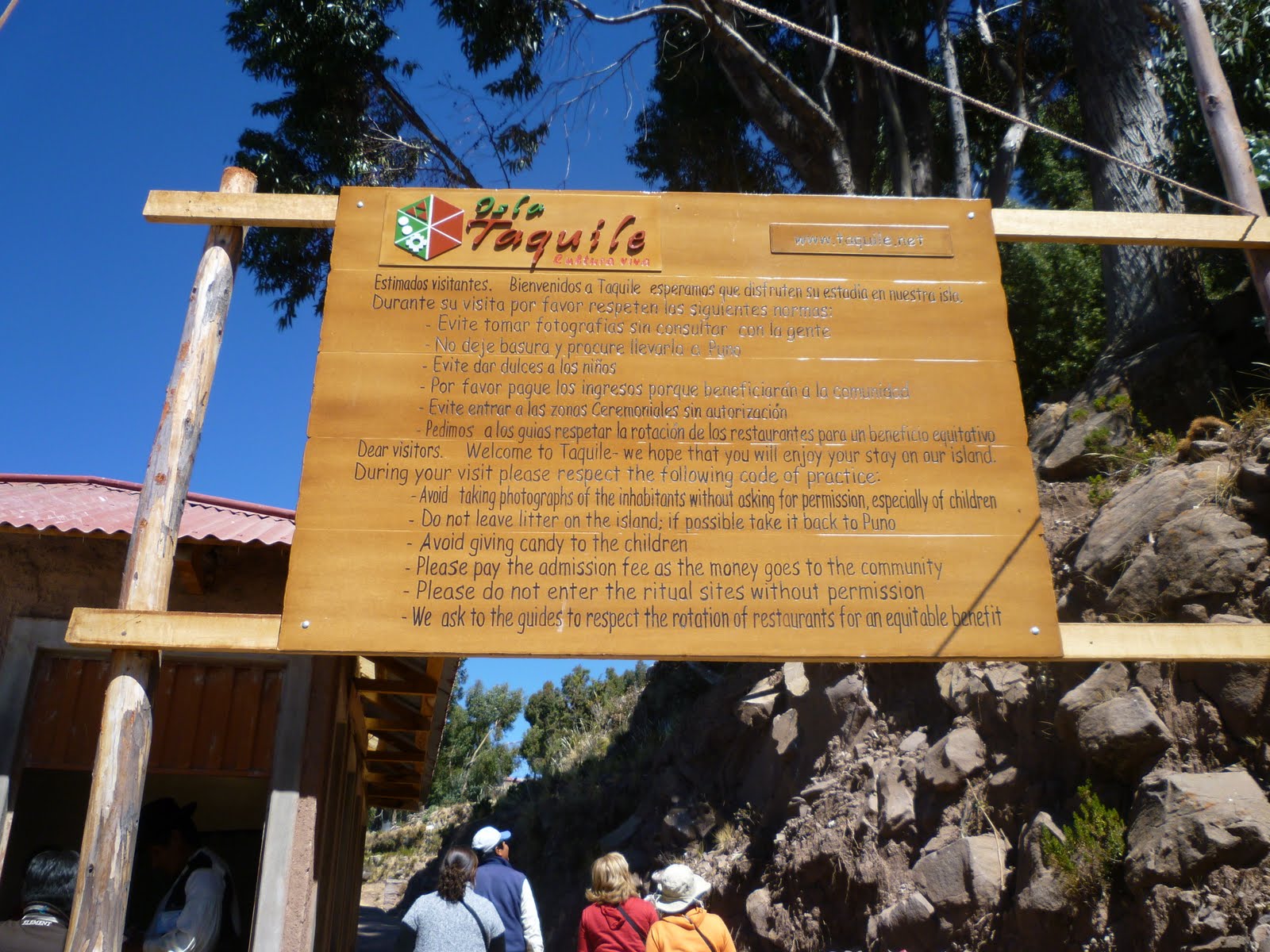
This sign announced the sights of Taquille, including the restaurant. This was the begining of the hike to the top. Of course, the vendors were at the gate to sell warm water, Inca Cola, and Coke.
Emma, wearing my hat, returned to the boat about 20 minutes after Dad and I gave up. She said her chest and head hurt. So while her grandpa slept, she and I hung out together on the top of the boat. We both were thoroughly sunburned. Emma bought her own hat at a market the next day.
As I was walking back to the boat after taking some pictures, these colorful people were just coming from one of the boats. Many were vendors coming to sell their handiwork. Others may live on the island.
This young woman had several packs of soda wrapped up in a blanket. I couldn't imagine having to carry such a heavy load, but she carried the load down the 500 stone steps to the boat.
This man has two gas tanks on his back. He also came down the stone steps.
This fellow dressed like a pirate was crew on a tourist boat filled with North Americans. Actually, I heard some British English as well. We were really grateful to have a private boat and guide.
Our guide said this terracing was done by a people who came before the Inca.
These are houses on the edge of Lake Titicaca. The animals graze on the terraces behind the homes.
We were pulling away from the boat dock to go to the side of the island where the Jeffries would descend the stone stairs when I took this picture.
Ted, Kate, and Spencer are crossing the bridge which leads to the boat dock. Kate bounded down the steps like a little mountain goat.
After we left Sicuani, on the last day of our Puno tour, we drove through the bustling streets of Juliaca where we had landed two days before. It was dark when we landed. We noticed the taxis as we drove through the city, making our way into the countryside, so Margaret asked Felix if we could return to Juliaca long enough to take some pictures before leaving for the day's journey to Cusco. With all the stops to take pictures and to visit unplanned sites, we were two hours late getting into Cusco. Felix and the driver had to make the six-hour return trip that night because he was guiding German tourists on a kayaking adventure the next day.
This taxi driver couldn't have been any older than 16.
Taxis carry people, fruits and vegetables, etc.
I loved this Quechua woman's coordinated look. I tried to get her face but she wouldn't look at me.
The seats look comfortable, no? If we had time to hang around Juliaca, we'd have taken a ride. We saw families and mothers and school children being driven somewhere. There are no other kinds of taxis in Juliaca.
This is one view of a city street in the early morning sunshine. By mid day, the sun will be warm enough to be in short sleeves. In the morning and evenings it's quite cool. Juliaca is at 13,000 feet. We climbed to Puno.
After we left Sicuani, on the last day of our Puno tour, we drove through the bustling streets of Juliaca where we had landed two days before. It was dark when we landed. We noticed the taxis as we drove through the city, making our way into the countryside, so Margaret asked Felix if we could return to Juliaca long enough to take some pictures before leaving for the day's journey to Cusco. With all the stops to take pictures and to visit unplanned sites, we were two hours late getting into Cusco. Felix and the driver had to make the six-hour return trip that night because he was guiding German tourists on a kayaking adventure the next day.
Monday, August 30, 2010
A Quechua Family Welcomes Us to Visit
Somehow I deleted this picture which is significant. This Quechua family grows their own grain. Felix is showing us the quinoa plant which the grandma is grinding in the background. They served us tasty biscuits made of quinoa and baked over an outdoor fire.

Three generations share this home. The grandfather is weaving a rug. The mother of the little girl is standing against the door of her bedroom. The room is simply furnished--just a bed and hooks to hang a few clothes.
The family built their own home after the manner of their ancestors--simple stone walls, stone patios, adobe walls and arch. They even made the ceramic pigs which adorn the arch.
We were taken by the two pigs which seem to be welcoming us.
The family grows several different kinds of potatoes or papas. The bowl in the center holds "clay" which we were invited to taste. All the potatoes and vegetables are dipped into the clay. It tastes like a salty clay.
Emma, Spencer, and Kate were fascinated by the clay idea and the potatoes were really tasty. We peeled the potatoes first.
Margaret and Kate wanted to have a picture with the llama but the llama wouldn't look at the camera.
The little girl and Kate are both 7. She was so shy, but she surprised us by asking for a dulce or caramelo (a piece of candy) as we were getting out of the van. Fortunately I had some M & Ms from tropical trail mix to give her. We also paid the family for letting us visit them. It's customary. I don't have a picture of their homemade goods for sale. I'd have loved to buy a rug but the father wanted 150 soles or the equivalent of $50 which isn't a bad price, but it was at the beginning of our trip and we had no extra room in our carry-on luggage. I did buy a small ceramic vase.
Kate's alpaca was more cooperative. Their wool is so soft. There is nothing softer than baby alpaca. A good quality baby alpaca sweater is fairly expensive.
The grandfather wanted to show us all about their family life. He was really good with the kids. This alpaca is really cute--His facial expression was like that of a loving, happy puppy.

Felix explained that the grandmother does all the cooking. In good weather they use their outdoor kitchen. During the rainy season, they cook in the windowless inside kitchen which is behind Felix.
The little girl would have nothing to do with the hat her mother wanted her to wear. She went into the house and chose one of her own. Little girls are the same everywhere.
Grandmother demonstrated grinding grain for bread. The method of grinding corn, wheat, or quinoa is the same as the North American Indians use. They served a coarse, quinoa biscuit which was really tasty.
We enjoyed this experience so much. We were much more than tourists while we were there. We were honored guests. Emma, Spencer, and Kate will take with them a rich understanding of the Quechua culture.
Two cute faces...Emma and her friend.
Felix, our guide for the Puno part of our trip, is Quechua Indian. He was born and reared in the Puno area, in fact, quite near Sicuani. He speaks Quechua, Spanish, and he is teaching himself German so he can guide German speaking tourists. He knows many of the families near the Inca burial towers. He asked friends, also Quechua, if he could bring by our family to meet them so we could have a personal experience.
This is the family's homestead from the back. I noticed it as we were driving toward Sicuani. Little did I know we would be visiting the home.
Felix explained that the grandmother does all the cooking. In good weather they use their outdoor kitchen. During the rainy season, they cook in the windowless inside kitchen which is behind Felix.
Buffet Lunch at the Puno/Cusco Line
Felix took us to a roadside buffet Javier had arranged for us. We had been on the road since early in the morning. The buffet of traditional Peruvian fare was really good. The kids enjoyed the buffet meals because they could eat what they wanted. My favorite dish was the arroz con leche, one of four choices for dessert in addition to ice cream which was pure cream frozen.

This picture is one of many I took of Dad on the phone. The Jeffries and I decided it will make a fun blog.
This llama, tied to the sign that marks the beginning of the route to Cusco, clearly is nearing the time for shearing. He was very peaceful, tame, and seemed to enjoy the attention.
There were other llamas or vicunas on the restaurant grounds, a petting zoo of sorts. The kids had a good time with them.
Emma took this picture of herself with the llamas. She is wearing my hat.
We passed villages like this one, a particularly picturesque village because of the typical mud wall enclosure, thatched roofs, and stone and mortar houses and, of course, the family dog and llama.
This is the year of elections for mayors and city councilmen. Alcade (pronounced al-caw-day) is Spanish for mayor. Many property owners allow the candidates to paint on their houses, walls and roofs. We learned that the candidates tell the owners they will repaint after the elections, but too often those promises are not kept. An interesting side note is that first weekend of October, General Conference weekend, no public meetings are allowed because of the elections. So church members in Peru cannot watch the satellite broadcast in the stake centers.
This is a little chapel in the middle of nowhere but is a community chapel. I wish we could have seen the front of it.
One could get the idea this is the queen llama. She has such attitude. Behind her is the typical market found at every stop along the Inca Road.
So after three days in Puno in Puno, 14,000 above sea level, we are really headed to Cusco which is only 12,000 feet. We arrived in Puno on Monday night, August 9th, after an hour drive from the airport in Juliaca. The air was so thin, we felt heady. We thought we were prepared for the altitude, but we weren't. So this day, Wednesday, everyone felt much better than the day before.
This picture is one of many I took of Dad on the phone. The Jeffries and I decided it will make a fun blog.
Sunday, August 29, 2010
From Puno to Cusco--Raqchi
The last stop we made before driving into Cusco (another 1 1/2 hours) was the community of Raqchi which today is a small but thriving farming community. Tourism is important to these people as well. The guide book says 90% of the community residents are devoted to pottery of different shapes and sizes. The pottery is sold all over Peru and is valued for the volcanic rock and clay mixture. We didn't buy any pottery. If I had read the guide book before we visited there, I would have picked something up. The people of Raqchi follow the traditions and patterns of ceramic art of the Ancients. The real draw, however, is the 1400s temple of the god of Wiracocha.
The chapel is made of volcanic rock thrown by a nearby volcano, Volcan Kinsachata, which gave to the Andean Indians a quarry of good building material. The road in front of the Catholic chapel is the great Inca road leading to Cusco. The guide book stated the road also ran as far as Argentina.
In Old Lima is a statue dedicated to the Pony Express of the Inca culture. Runners ran relay-style from Colombia, through Ecuador, through the small towns of Peru to Cusco and then on to Lima. From Peru they ran into Bolivia and then to Chile.
The temple is in the background. Living quarters connected to the temple are actually in the form of a neighborhood with a narrow road or alley way running between perfectly symmetrical houses with adjoining patios. The guide book said the priests and virgins lived here.
As we were approaching Raqchi, our guide Felix pointed out the Inca stairway on the outside of an ancient wall. This wall is part of the ancient wall that surrounded the community and ran along the Inca Trail to Cusco, the seat of the Inca Empire.
This is the residence for the priests and virgins. When the Spanish conquered the Inca, they plundered their silver and gold, took their idols which were kept in niches found in all the Inca ruins, and destroyed many of the temples as they strove to wipe out their pagan practices. They used the stones of the Inca temples to build their own cathedrals. One thing we have learned, however, about these Ancients is they had a belief in a heaven or pre-earth life and a belief in life after death. Earthlife was very important to them as well and they named the earth Pachamama. (They offered sacrifices to Pachamama for good crops, favorable weather, etc.) They buried their dead with precious belongings and food to carry with them to the next life. Their jewelry and pottery reflect these beliefs--the Inca cross, the eternity circles, and even the mysterious mountain petroglyphs or art, one which has a a giant "tree of life" which the locals call the "candelabra." There is a picture of that candelabra or tree on a January blog.
Notice the Inca blocks of stone fit together without mortar. Above the foundations the walls are of pure adobe or rolled clay.
This Inca community had storage bins or "silos" for storing potatoes and grain which were discovered in the 1960s when the site was discovered by archeologists. Farmers had been using the land for centuries, but only when Peru began preserving their archeological sites, did this area become important. The guide book states that the Inca leaders in this community made sure no one went without food. It reminded us of the church welfare program which provides humanitarian services and food for the needy and not just members of the church. Emma is standing in the doorway of a silo that was found in perfect condition. In it was evidence of potatoes and grains.
Only the wall on the right has been restored to show what the design of the temple was originally.
One picture we didn't get was the Inca baths. The Incas had hydraulic engineering knowledge. The water is distributed by perfectly preserved stone channels which run underground and distribute pure, clear cold water to the west and east sides of the platforms. No one has discovered the source of the water but it flows "non stop" according to the guide book.
Subscribe to:
Posts (Atom)