When Margaret and Ted were here with Emma, Spencer and Kate, we toured the Sacred Valley's ancient ruins. Our guide led us through the ancient city to Ollaytantambo, an ancient Inca city. Pictures of Ollaytantambo are on the blog of our trip. On this trip with the mission presidents we stopped in the ancient city's town square for just a 5-minute look around. The 5 minutes stretched into 10 minutes, just enough time for some fun pictures.  I followed the wife of one of the Lima mission presidents up a steep sidewalk overlooking the ruins which you can see in the background. In August Ted, Margaret and Kids climbed those terraces while Dad and I toured the sights below and took pictures of the Jeffries who were scampering about like mountain goats. We didn't have an opportunity to explore the little city itself then so this was a fun experience and a different perspective.
 This passage way is an untouched, 15th Century sidewalk, the only truly original street left in Pisaq. I wish we had had time to walk the length of the passage.
 This woman let me take her picture. I offered her a sole, the equvalent of 35 cents.
 This is one of the markets in the square--a market on bicycle. When were were in Pisac with the Jeffries, the square was congested so much with buses, trucks, and cars, the driver of our small van had difficulty turning the van around to exit the city square. This time the square was not congested. It was fun to walk the ancient square and look at the markets.
Dad and I had the wonderful opportunity to attend the 2010 Mission Presidents' Seminar for the South America Northwest Area comprised of 23 missions and two CCMs in five countries. The seminar was in Spanish but a member from Cusco interpreted for the North Americans like me who still struggle with the language. The road from Cusco to the Sacred Valley is steep. The view from the top is spectacular. The surprise is the descent into the Sacred Valley. Cusco is at 12,000 feet and the Sacred Valley is about 10,000 feet altitude.
 We were in Group One which meant we were picked up early in the morning and were on the first flight to Cusco, arriving about 10:30 in the morning. A tour bus took us to a resort hotel in the Sacred Valley, a nearly two-hour trip with vistas and fun views at every turn.
 The Inca laid out Cusco in the shape of a puma with the head at the far left and the tail off the photo to the right. Can you see the head?
 The varied architecture was fascinating. The following pictures show the variety of styles and building techniques.
 This is a fairly old family home made of handmade bricks covered with mud adobe.
 This is quite a creative design. The stones reflect the Inca walls--stone on stone with no mortar. The thatched roof and tower-like structure is common in the valley. We saw a village of smaller homes in the same style. They reminded us of yurts.
 Decorations of painted adobe shapes is quite common too. The owners have also repeated the Inca motif on one outside wall.
 This style of architecture is really common in Peru. The owners probably live above the store. The house is actually four box-like structures combined to make a larger home.
 This house/restaurant is really fun! All the decorative arts are combined in one building. We saw one family slapping the adobe on their home to make shapes. We could tell one shape was the alpaca.
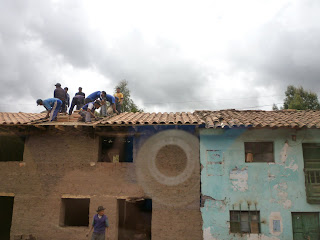 Our Quechua guide told us this is a common sight--a kind of neighborhood project to get a tile roof laid before the expected rain.
 The white streaks are salt. Once the salt forms from the salt lake running beneath the falls, it rises and hardens. The it is cut into sheets and carried away for market.
 Houses cost little to nothing to build. The valley is rich in soil which makes good bricks and grows crops. These are bricks lying in the sun to dry.
 The Sacred Valley or Valle Sagrada was so named by the Inca because of the rich volcanic soil which yields crops and the Urubamba River which runs the length of the valley all the way to Machu Picchu. Several varieties of corn are grown in the valley.
 Because of the tinted windows in the bus, the colors are distorted. This valley was like a patchwork quilt. The patchwork effect goes up into the hills.
 Hyrum Bingham who is attributed with the discovery of Machu Picchu followed this river with his expedition party. The river is more blue-green than the picture shows.
 Many markets dot the route from Cusco to Machu Picchu. Our guide encouraged us to buy from the local people because their only sources of income are their handiwork and produce.
 The potato crop was in bloom with purple flowers. The color really doesn't show up well in the pictures, but the land was carpeted in purple.
 We wondered if so many bricks laid out to dry meant this farmer was in the brick making business.
 The roadside soup kitchen is a common sight as well. In every town, even here in La Molina and the other nearby districts, family run businesses like this one are allowed. In the health classes Stuart instructs the missionaries not to eat the "street food," however, because there is no control on quality or cleanliness.
 Many markets like this one are really neighborhood co-ops, a few families joining together near an historic site.
 Dad and I love this scene which was repeated several times as we traveled to the Sacred Valley--a shepherd with a dog, a farmer with his oxen, a child with his donkey--all rural scenes of day to day life.
On arrival, our bus driver entered through massive Colonial style gates into this hidden hotel resort. The flower pots, fountain, and white walls were just a tease of the floral paradise--cloistered gardens, rolling lawns with grazing alpaca and llama, fountains, lagoons, and all manner of stately palms, evergreens, and flowers Utahns know as house plants. The resort is another Blog...
 I followed the wife of one of the Lima mission presidents up a steep sidewalk overlooking the ruins which you can see in the background. In August Ted, Margaret and Kids climbed those terraces while Dad and I toured the sights below and took pictures of the Jeffries who were scampering about like mountain goats. We didn't have an opportunity to explore the little city itself then so this was a fun experience and a different perspective.
 This passage way is an untouched, 15th Century sidewalk, the only truly original street left in Pisaq. I wish we had had time to walk the length of the passage.
 This woman let me take her picture. I offered her a sole, the equvalent of 35 cents.
 This is one of the markets in the square--a market on bicycle. When were were in Pisac with the Jeffries, the square was congested so much with buses, trucks, and cars, the driver of our small van had difficulty turning the van around to exit the city square. This time the square was not congested. It was fun to walk the ancient square and look at the markets.


